which igneous rock contains the greatest amount of quartz
Chapter 3 Meddling Igneous Rocks
3.4 Classification of Igneous Rock
As has already been described, igneous rocks are confidential into four categories: felsic, intermediate, mafic, and ultramafic, based on either their chemistry or their mineral composition. The plot in Figure 3.4.1 can be accustomed assistance classify igneous rocks by their mineral composition. An important characteristic to note on this plot is the red line separating the not-ferromagnesian silicates in the lower left (K-feldspar, quartz, and plagioclase feldspar) from the ferromagnesian silicates in the upper right (biotite, amphibole, pyroxene, and olivine). In classifying intrusive eruptive rocks, the first matter to deal is the percentage of ferromagnesian silicates. In most igneous rocks the ferromagnesian silicate minerals are clearly darker than the others, but information technology is still quite difficult to estimate the proportions of minerals in a rock.
Based on the positioning of the red line in Figure 3.4.1, it is evident that felsic rocks can have betwixt 1% and 20% ferromagnesian silicates (the red line intersects the left side of the felsic partition 1% of the distance from the top of the diagram, and IT intersects the right side of the felsic zone 20% of the distance from the top). Intermediate rocks have betwixt 20% and 50% ferromagnesian silicates, and mafic rocks have 50% to 100% ferromagnesian silicates. To be more taxonomic category, felsic rocks typically have biotite and/or amphibole; intermediate rocks have amphibole and, in some cases, pyroxene; and mafic rocks have pyroxene and, in some cases, olivine.
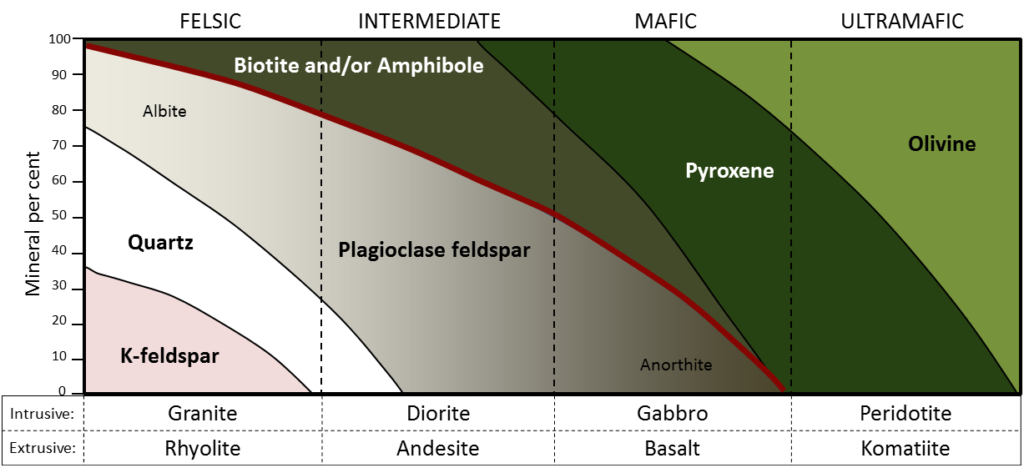
If we revolve about the non-ferromagnesian silicates, it is evident that felsic rocks posterior have from 0% to 35% K-felspar, from 25% to 35% quartz (the vertical heaviness of the quartz field varies from 25% to 35%), and from 25% to 50% plagioclase (and that plagioclase will be sodium-rich, or albitic). Intermediate rocks can have up to 25% quartz and 50% to 75% oligoclase. Mafic rocks lone have plagioclase (up to 50%), and that plagioclase will be Ca-rich, or anorthitic.
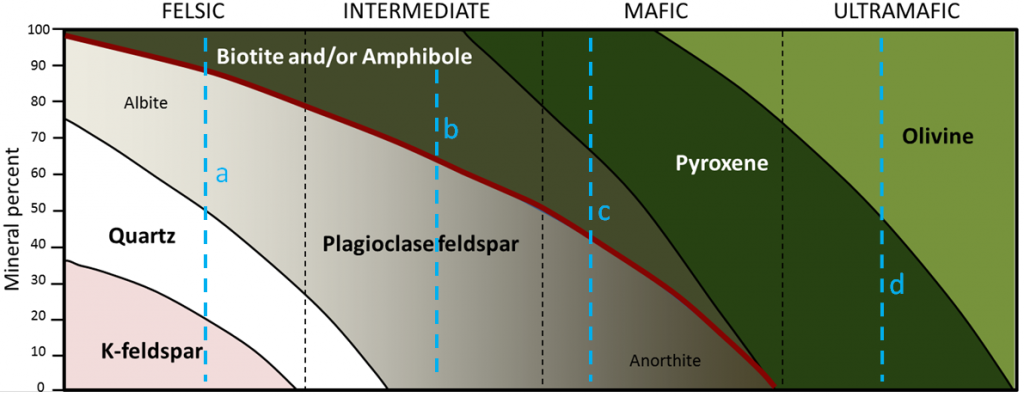
The dashed blue lines (labelled a, b, c, d) in Bod 3.4.2 represent four eruptive rocks. Complete the table aside estimating the mineral proportions (percent) of the quaternion rocks (to the nearest 10%).
Hint: Rocks b and d are the easiest; start with those.
| Rock | Biotite/amphibole | Pyroxene | Olivine | Plagioclase | Quartz | K-feldspar |
|---|---|---|---|---|---|---|
| a | ||||||
| b | ||||||
| c | ||||||
| d |
See Appendix 3 for Drill 3.5 answers.
Form 3.4.3 provides a diagrammatic representation of the proportions of dark minerals in light-coloured rocks. You can use that when trying to estimate the ferromagnesian mineral happy of actual rocks, and you can get some practice doing that by additive Physical exertion 3.6. Be warned! Geology students almost universally finished-estimate the proportion of dark minerals.

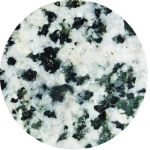
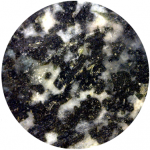
The four igneous rocks shown below deliver differing proportions of ferromagnesian silicates. Estimate those proportions using the diagrams in Figure 3.4.3, and then exercise Work out 3.4.1 to determine the possible rock name from each one.
 |  | 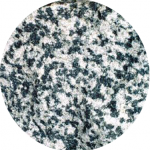 | 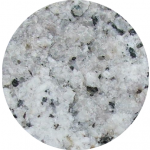 |
| ___ % | ___ % | ___ % | ___ % |
| __________ | __________ | __________ | __________ |
See Appendix 3 for Exercise 3.6 answers.
Igneous rocks are also top-secret reported to their textures. The textures of extrusive rocks will be discussed in Chapter 4, so hither we'll only look at the different textures of intrusive igneous rocks. Almost all intrusive igneous rocks take crystals that are Brobdingnagian sufficiency to see with the nude eyeball, and we use the term (from the Greek word phaneros meaning visible) to describe that. Typically that means they are large than astir 0.5 millitmeres (mm) — the heaviness of a strong course made with a ballpoint pen. (If the crystals are also small to separate, which is typical of most unstable rocks, we use the term (from the Greek word aphanos – undetected) The intrusive rocks shown in Figure 3.3.5 are all phaneritic, as are those shown in Drill 3.6.
In gross, the size of crystals is relative to the grade of cooling system. The longer information technology takes for a body of magma to unagitated, the larger the crystals can grow. It is not uncommon to see an intrusive igneous sway with crystals up to 1 centimetre (cm) long-dated. In some situations, especially toward the end of the cooling degree, the magma can get ahead H2O rich. The presence of musical weewe (still liquid at high temperatures because it is under pressure) promotes the relatively easy movement of ions, and this allows crystals to mature large, sometimes to single centimetres (Count on 3.4.4). Finally, American Samoa already described, if an igneous rock goes through with a two-stage cooling system process, its texture will represent porphyritic (Estimate 3.3.7).

Image Descriptions
| Igneous Rocks | Felsic | Intermediate | Mafic | Ultramafic |
|---|---|---|---|---|
| K-felspar | 0 to 35% | 0% | 0% | 0% |
| Quartz | 25 to 35% | 0 to 25% | 0% | 0% |
| Plagioclase feldspar | 25 to 50% | 50 to 70% | 0 to 50% | 0% |
| Biotite and/operating theater Amphibole | 0 to 20% | 20 to 40% | 0 to 30% | 0% |
| Pyroxene | 0% | 0 to 20% | 20 to 75% | 0% to 75% |
| Olivine | 0% | 0% | 0 to 25 % | 25% to 100% |
| Intrusive | Granite | Diorite | Gabbro | Peridotite |
| Extrusive | Rhyolite | Andesite | Basalt | Komatiite |
[Return to Figure 3.4.1]
Attributions
- Figure 3.4.1, 3.4.2, 3.4.3: © Steven Earle. CC BY.
- Figure 3.4.4: Pegmatite. Unexclusive domain.
which igneous rock contains the greatest amount of quartz
Source: https://opentextbc.ca/physicalgeology2ed/chapter/3-4-classification-of-igneous-rock/

Posting Komentar untuk "which igneous rock contains the greatest amount of quartz"